
Latest Cochrane research confirms HPV vaccination prevents cervical cancer
Two new Cochrane reviews show strong and consistent evidence that HPV vaccines are effective in preventing cervical cancer and pre-cancerous changes, especially when given to young people before they are exposed to the virus.
The reviews are:
Girls vaccinated before the age of 16 were found to be 80% less likely to develop cervical cancer. The reviews also confirm that HPV vaccines are only likely to cause minor, transient side effects such as a sore arm. The reviews were supported by the National Institute for Health and Care Research (NIHR).
Human papillomavirus (HPV) is a family of common viruses, including the viruses that cause skin warts. Whilst many types of HPV are harmless, other ‘high-risk’ types can cause cancers of the cervix, anus, penis, vulva, vagina, and throat, and others cause anogenital warts. Cervical cancer is the fourth most common cancer in women worldwide and causes more than 300,000 deaths each year, mostly in low- and middle-income countries. The new reviews confirm that vaccination against HPV can prevent most of these cancers from developing.
Clinical trial evidence supports effectiveness and safety
The first review focused on randomized controlled trials and included 60 studies with 157,414 participants. They found that all HPV vaccines were effective in preventing infections that can lead to cancer and other HPV-related conditions, with no evidence of serious safety concerns.
Because cancers caused by HPV can take many years to develop, most studies did not follow participants long enough to measure direct effects on cancer itself. However, vaccines such as Cervarix, Gardasil, and Gardasil-9 reduced precancerous changes in the cervix and other tissues in people aged 15 to 25 years, as well as the number of people needing treatment for HPV-related disease. The vaccines that included protection against the relevant HPV types significantly reduced the risk of anogenital warts.
Short-term side effects like mild pain or swelling at the injection site were common, but serious side effects were rare and occurred at similar rates in both vaccine and control groups.
“Clinical trials cannot yet give us the whole picture on cervical cancer, as HPV-related cancers can take many years to develop,” says Hanna Bergman, co-lead author. “That being said, the evidence from these trials confirms that HPV vaccines are highly effective at preventing the infections that lead to cancer, without any sign of serious safety concerns.”
Real-world evidence confirms long-term protection
The second review analyzed evidence from 225 studies involving more than 132 million people across multiple countries. It looked at observational study designs, including population-level studies comparing outcomes before and after introduction of the vaccine. Findings show that HPV vaccination clearly reduces the risk of developing cervical cancer and pre-cancerous changes of the cervix. The results came from studies of various designs across different follow-up periods.
Girls vaccinated at or before the age of 16 were 80% less likely to develop cervical cancer than unvaccinated girls. The review also found substantial reductions in pre-cancerous changes (known as CIN2+ and CIN3+), and in anogenital warts, which are also caused by HPV infection. Reductions were greater in people who received the HPV vaccine at or before the age of 16.
Importantly, the review found no evidence to support claims that HPV vaccination increases the risk of serious adverse events. By cross-referencing alleged adverse events with real-world follow-up data, the review team found no relationship between reported serious side effects and HPV vaccination.
“We now have clear and consistent evidence from around the world that HPV vaccination prevents cervical cancer,” says Nicholas Henschke, co-lead author. “An important finding was that the commonly reported side effects of the vaccine, often discussed on social media, were found to hold no evidence of a real link to vaccination.”
Global impact and next steps
Together, the two Cochrane reviews provide the most comprehensive and up-to-date evidence on HPV vaccination to date, drawing from both large-scale real-world studies and rigorous clinical trials. Evidence shows that HPV vaccination is a safe and highly effective public health measure, capable of preventing cancers that affect hundreds of thousands of people every year.
The findings underscore global recommendations to vaccinate both girls and boys, ideally before the age of 16, to achieve the greatest protection against HPV-related cancers. Protection is strongest when vaccination occurs before sexual debut and exposure to the virus.
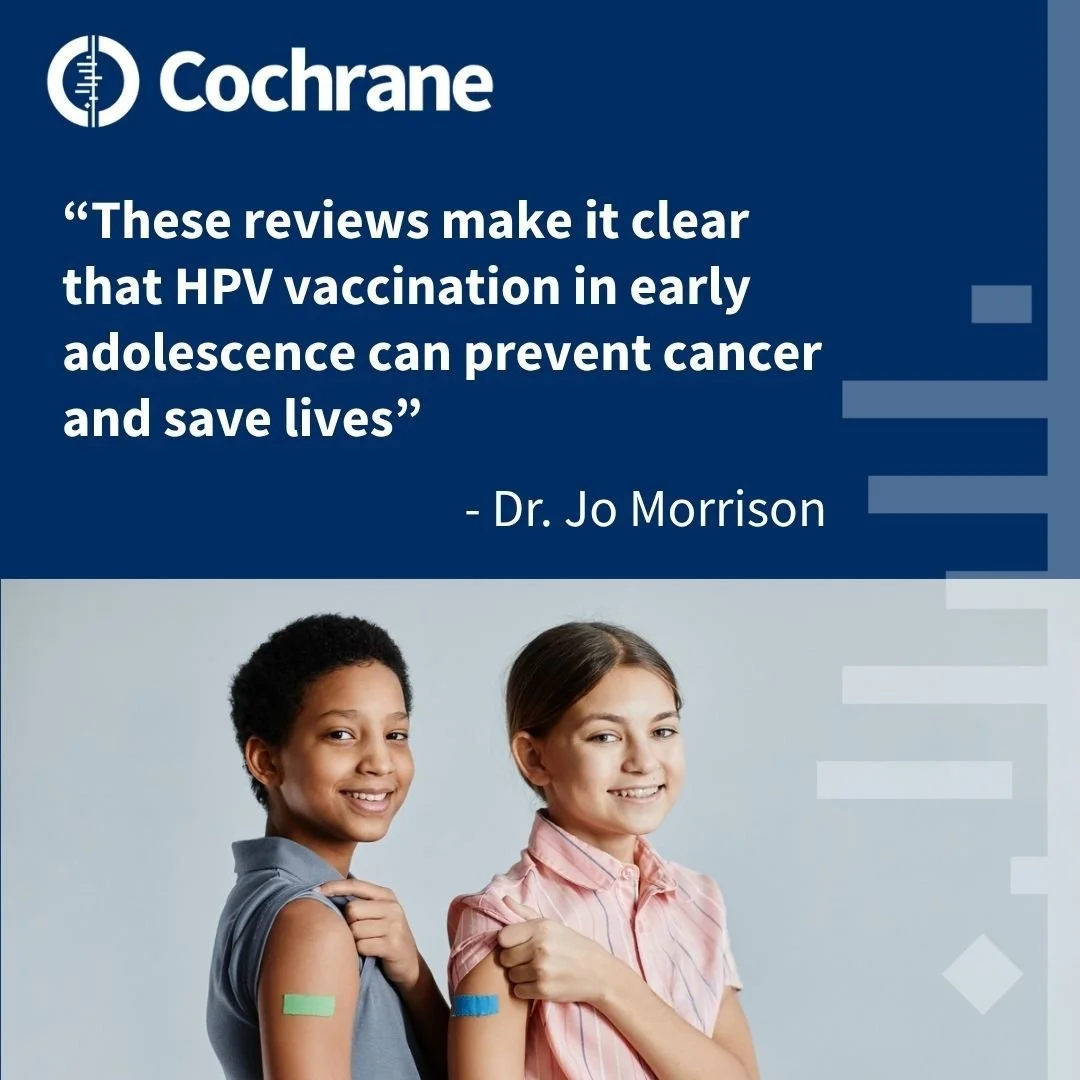
“These reviews make it clear that HPV vaccination in early adolescence can prevent cancer and save lives,” says Dr Jo Morrison, senior author, gynaecological oncology consultant at Somerset NHS Foundation Trust and Honorary Associate Professor at the University of Exeter. “Vaccinating boys as well as girls boosts protection for everyone. Over time we’ll see the impact of vaccination on other cancers too, including ones that affect men.”
However, the authors also note some evidence gaps. Most research has been conducted in high-income countries, meaning more studies are needed in low- and middle-income settings, where cervical cancer is more common and screening programs are lacking; it is in these countries that HPV vaccination will have an even more positive impact. However, to achieve the World Health Organisation’s ambition to eradicate cervical cancer, high rates of HPV vaccination, cervical screening and treatment of pre-cancers detected by screening remain crucial.
“Longer-term data will continue to strengthen our understanding of how HPV vaccination protects against cancer over a lifetime. Whilst we now have sufficient data to see a beneficial effect of HPV vaccination on cervical cancers, which tend to develop in younger women, it will take decades to fully understand the impact of vaccination on vulval, peri-anal, penile and head and neck cancers which often develop later in life,” says Dr Morrison.
What do we know about the HPV vaccine?
Learn about HPV as we answer common questions and explore how vaccination can protect children.
The bottom line for caregivers
1. The HPV vaccine offers protection from cervical cancer, genital warts and other diseases caused by HPV
2. The vaccine is most effective before people are exposed to HPV, which is why it’s offered to children and young adolescents
3. The side effects of vaccination are minor and short-term, with most people experiencing a slightly sore arm for a day or two
Understanding HPV
What is human papillomavirus (HPV)?
HPV is a family of common viruses that live on the skin, including around the mouth, throat and genitals. Human papillomaviruses have been with us for millennia, dating back to early human ancestors and Neanderthals. They spread through close contact, including sexual activity.
Nearly everyone will get HPV at some point in their lives. Many infections will be harmless and are cleared by our immune systems. However, some people don’t clear the virus properly. These ‘persistent infections’ can cause cancer after several years.
Cervical cancer is strongly linked to HPV infection. In fact, more than 95% of cervical cancer cases are caused by HPV.
Cervical cancer is most often diagnosed in young women, aged 25 to 35 years.
HPV infections can also cause cancer of the vagina, vulva, anus, penis, head and neck, and anogenital warts (warts that that involve the anus and the genitals).
Why does my child need the HPV vaccine?
Cervical cancer is the 4th most common cancer worldwide, causing more than 350,000 deaths each year. The good news is that cervical cancer is one of the few cancers that can be prevented by a simple vaccine. Vaccination can prevent the types of HPV that cause cancer and anogenital warts.
Who is most at risk?
Cervical cancer can be reduced in countries that have highly effective screening and treatment programmes. However, HPV vaccination has the biggest impact in countries that don’t have the resources for screening and treatment programmes.
Cervical screening, to find and treat people with the precursor changes to cancer (cervical pre-cancer), is still important. This is still true, even if you have been vaccinated. The vaccines do not cover every HPV that causes cancer, just the most common. The aim to eradicate cervical cancer globally needs a combination of vaccination, screening and treatment for pre-cancer.
Currently, more than 85% of all cervical cancer deaths occur in low- and middle-income countries. Our data shows that almost all of these could be prevented through routine HPV vaccination, screening and treatment of pre-cancer.
What’s new?
We wanted more information on long term and rare outcomes of the HPV vaccine that one-off studies can't answer. So, we reviewed two types of studies:
Population-level studies (real-world data from millions of people)
Randomized controlled trials (scientific studies comparing vaccinated and unvaccinated groups)
The results were clear; HPV vaccination of young adolescents protects people from[Ga6] cancers and genital warts, with only minor short-term side-effects.
Does the HPV vaccine work?
We looked at 225 studies, including 132 million people across multiple countries. The findings showed that if girls have the HPV vaccination before the age of 16, they have an 80% lower risk of cervical cancer compared with those who were not vaccinated. But how effective the vaccine was depended on the age it was given.
The research also showed the vaccine protected children from anogenital warts and cell changes, which can be a precursor to cancer. However, some HPV-related cancers take even more years to develop. For these cancers the long-term effects of the vaccine are still being studied and the evidence is more limited.
The take home message is that this works. Vaccinating girls and boys protects them from cervical cancer, helping them to lead happy and healthy lives.
Is the HPV vaccine safe?
Our reviews found that some minor reactions such as local pain and swelling were found after HPV vaccination, but there were no serious harmful effects.
On top of this, we looked specifically for evidence about common concerns about HPV vaccines. We thoroughly investigated the top 10 side effects reported on social media, including chronic fatigue syndrome/myalgic encephalomyelitis (CFS/ME), complex regional pain syndrome and paralysis. None are linked to the vaccine.
A worry for parents is often whether the HPV vaccine causes infertility. Our review found with high certainty that the HPV vaccine does not cause fertility problems.
However, cervical cancer and its treatments can lead to infertility. For example, people with cervical cancer might receive chemotherapy or radiation, or need surgery to remove their womb. Getting the vaccine and reducing the likelihood of cervical cancer protects fertility.
“If you vaccinate when you're under 16 then there’s an 80% decrease in the number of cervical cancers that we’re seeing. And that’s just amazing that we can do that.”
- Dr Jo Morrison, Consultant Gynaecological Oncologist, Somerset NHS Foundation Trust
Getting vaccinated
Why should we give the HPV vaccine at such a young age?
Vaccination is most effective when it is given before children come into contact with HPV, which is normally through close sexual contact. That’s why giving the HPV vaccination to children before they are 16 years old protects them before they are exposed.
Some parents are concerned that giving the HPV vaccine at a young age encourages children towards riskier sexual behaviour or earlier sexual activity. But our review shows no link between HPV vaccination and increased or earlier sexual activity.
Do boys need the HPV vaccine too?
Anyone can get and spread HPV. We know that vaccinating boys protects them from HPV infection and anogenital warts. It could also help to prevent other forms of cancer, although the evidence is less certain. HPV can cause head and neck cancers, as well as penile and anal cancers. As these cancers tend to develop later in life, there has not been enough time since HPV vaccinations were introduced to study the impact on these cancers.
Vaccinating boys also improves ‘herd immunity’, reducing rates of HPV in the overall population and giving better protection to girls too.
How can we get the HPV vaccine?
It is easy to get vaccinated. More than 145 countries have integrated HPV vaccines into routine immunisation schedules. In some countries you need to take your children to see a healthcare professional, other countries provide programmes through schools and all you have to do is sign a consent form.
Find out more
· Learn more about the new evidence
· UNICEF's fast facts about HPV and cervical cancer
· Information on HPV from GAVI
· Read about Pakistan’s HPV vaccination campaign
· Discover how public health professionals can overcome vaccine hesitation
